

The show closes with a coat that asks for nothing: clean line, pointed collar, below the knee. All the work sits on the surface, where an outsize printed rose and a line of red text on white run down to the hem and dissolve into burgundy. What is left of the coat is the printed figure.
The house was founded in Antwerp in 1986 by Dries Van Noten, one of the Antwerp Six, and for close to forty years its signature was cloth sourced far away and prints people collected. Van Noten retired in June 2024; after the seasons signed by the studio, womenswear and menswear have been with Julian Klausner since December 2024, and this is his fourth women's collection.
The clothes are wearable and the tailoring is in good order. We are puzzled all the same, because the resemblance to the house is not where it seems to be: every code is present, but the place where the collection means something has moved from cloth to image.
A WHOLE FILM IN ONE IMAGE
Klausner describes his starting point as "this very universal feeling of sometimes wanting to feel glamorous, sometimes wanting to feel like a star", which says what the collection wants a woman to feel before it says anything about the cut. The method arrives in his next sentence, about "telling the full story [of the movie] in one image". The studio began with old film posters and invented pulp titles for films that do not exist, Vipère among them, compressing each story into a single picture; the wardrobe that comes out of it is built to be looked at.
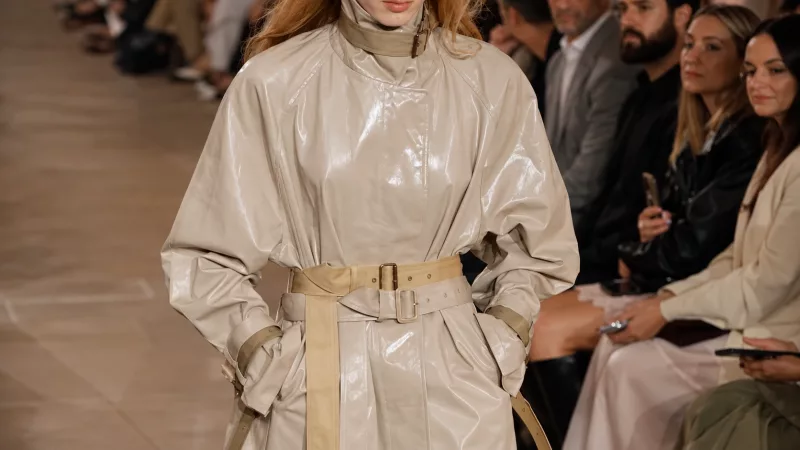
On the clothes the translation is literal. The print has stopped being a textile motif and become a photographic image carrying words. The show opens with a camel coat worn open, glossy lining, sleeves rolled back, over a dress printed with enlarged hands on a dark ground and lettering along the hem; later a sleeveless top carries a graphic that imitates a magazine cover, and a skirt takes up the printed hands again. Colour follows the same movement: brown, camel and greys break in the middle into acid yellows and metallic pinks, then close on blacks, purples and burgundies crossed by red graphics.
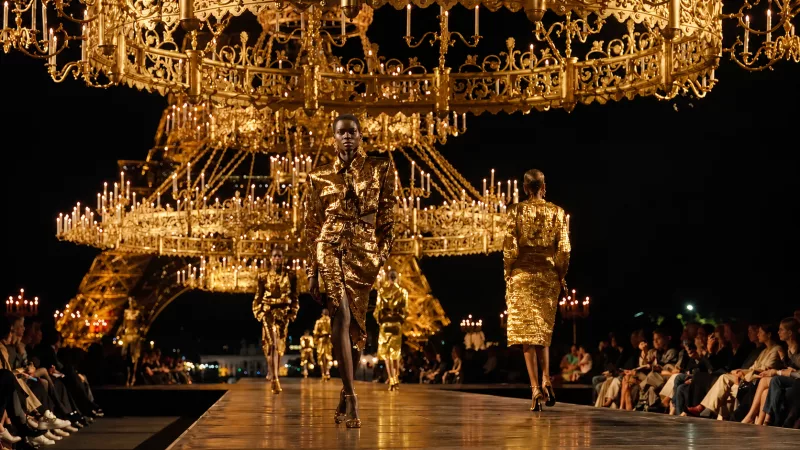
The sound comes from outside too: street noise recorded on the Quai Malaquais, in front of the house's Paris shop, so the city Klausner talks about is the one behind the door.
THE CUT HOLDS, THE ORNAMENT RISES TO THE SURFACE
A great deal of this is well made. The undone tailoring is where it should be, with blazers and jackets worn open and sleeves rolled back, while the fine-striped shirts have an impeccable fit and a run of buttons left irregularly undone, and the Bermuda shorts stay wide. These pieces sit inside the language of the house.
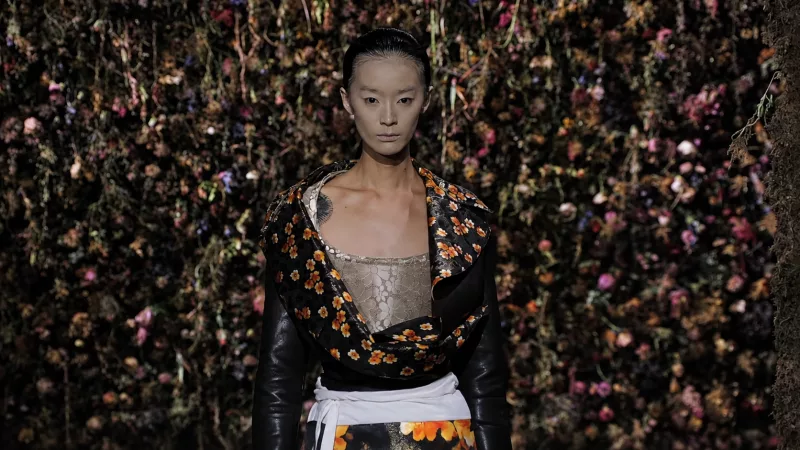
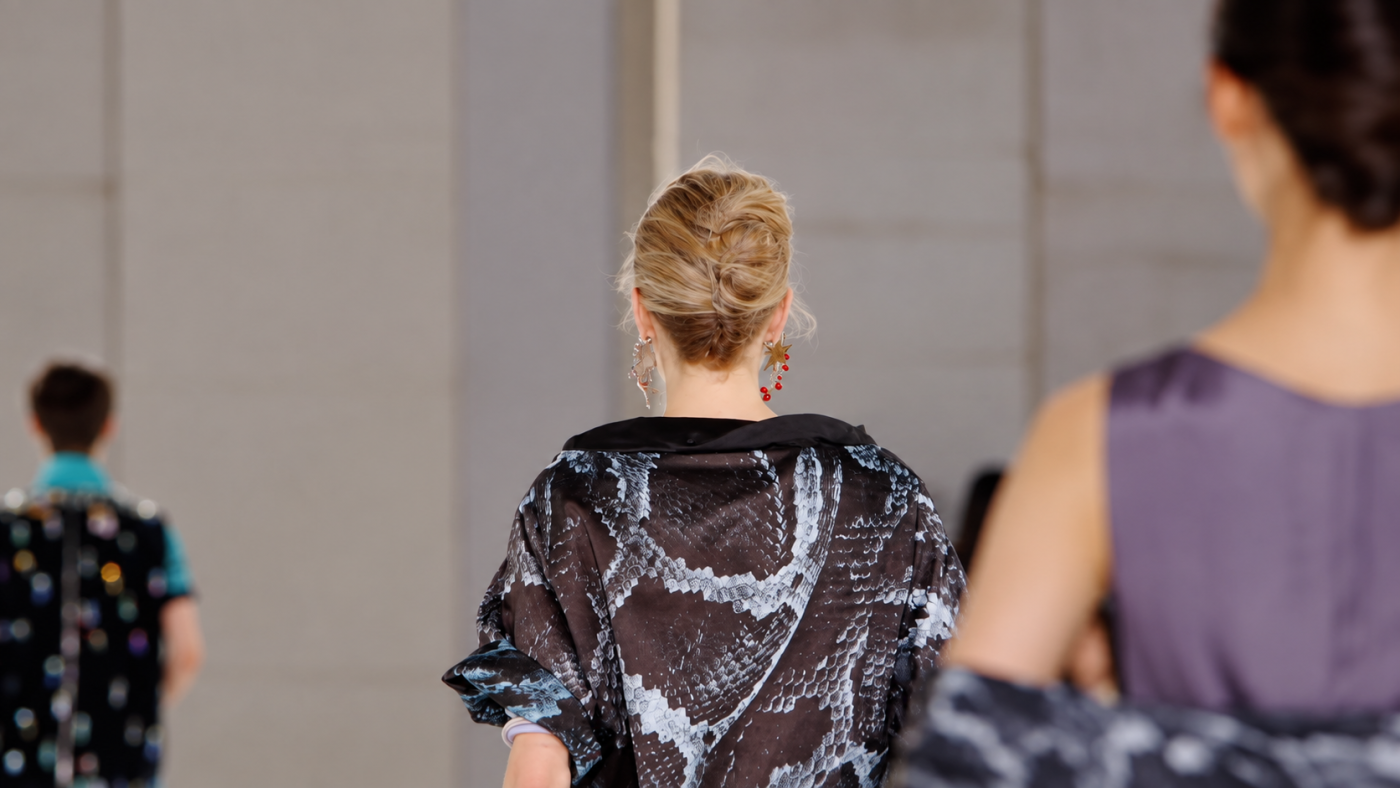
From a certain point on, though, the work moves to the surface. An animal-print cargo skirt is covered by a sheer outer layer with four large patch pockets, so the layering remains while the layer one sees first is a veil. On an olive tailored jacket with broad lapels and sleeves rolled back over a lilac lining, stones, crystals and drops cover the cloth densely above a striped polo knit, and the skirt that goes with it is faced with drops of its own. The trench, double-breasted and worn open, is embroidered across the upper body with stones, brooches and pendants, over a dress with a veiled printed bodice whose skirt, from the knee down, becomes a thick structure of outsize fringed sequins. The classic garment stays classic, and the image is made by what has been applied on top of it.
One can object that the codes are all there, that Klausner says he is taking them up, and that casual glamour is precisely what we saw. That is true, and the point is not that the codes are missing: it is where the attention ends up. Klausner himself calls this wardrobe a believable proposal for walking around the city, and the clothes bear him out; but the curiosity that built this house was for cloth, and here it is for pictures.
Inside those printed figures there is a name, and it is not the founder's. "I'm so used to seeing Dries's name everywhere. I have to get used to it, but it's fun to think that somebody will be walking around with my name on their dress," Klausner said after the show. The signature of the house has changed position, from the label to the surface, and at the fourth collection what it has gained in image it has spent in cloth.