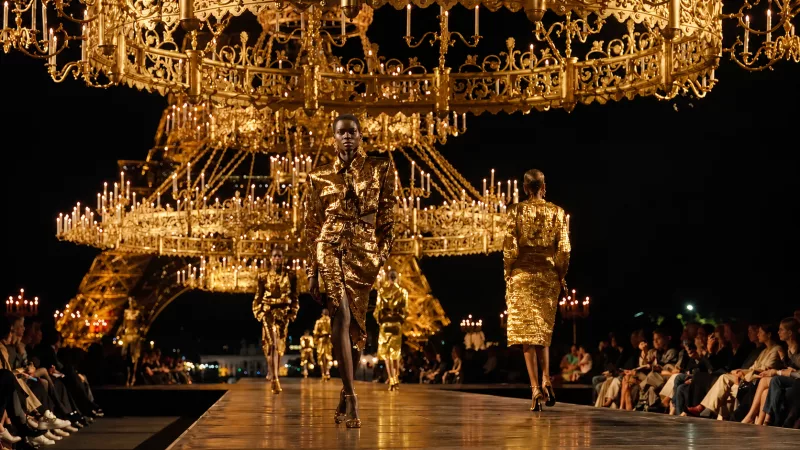


In Paris, in its thirtieth year, Jonny Johansson questioned why his own house keeps showing in the city at all. "I think about us sometimes when we go here [Paris]. I'm like, 'are we going here like a ship trying to bleed out creativity?'", the designer said after the show, comparing Acne Studios' presence in Paris to the Vasa, the Swedish warship that sank in 1628.
A founder doubting his own creative ambition on the anniversary would be a story on its own; what convinces us is the answer he gave in the clothes.
Acne Studios was founded in Stockholm in 1996 and Johansson has designed it from the beginning, which rarely happens in a house turning thirty. The collection is called "Denim Hystoria", and it threads the label's own history through historic dress: Johansson took the five-pocket jean of 1996, the first the house made, and pushed it to the point where it stops being denim and starts being a period garment.
Denim remains the base material, and trousers hold the collection up, appearing in 45 of the 50 looks, straight-legged or cut close to the calf, sometimes as the foundation for something stacked on top. What Johansson changes is the scale and the sign. The jean takes on rococo shapes and sits beside details borrowed from historic dress, corsetry, brocades, brooches, puffball skirts. He has explained that he wanted to bring the idea of that first five-pocket together with elements of period dress precisely to produce tension, and he named the London New Romantics as the trigger for the collision, which the room confirmed through Frédéric Sanchez's soundtrack playing "Prince Charming" by Adam and the Ants. The utilitarian minimalism the Swedish house built its name on is subverted from inside, not abandoned.
The clearest instance comes early in the show, in a blue top with a shiny surface, a gathered high neck and cut-outs at the hips, carrying an enormous knot at the front that opens into a ruched volume falling to mid-thigh, worn over aged and faded beige trousers fitted to the calf. The waist, which in tailoring is the most stable reference a garment has, ends up buried under hand-knotted drapery instead of being marked by a seam. The same move returns shortly afterwards in magenta, where a draped fabric rose occupies the space between the waist and the upper thigh.
What holds the show together, though, is the horizontal stacking. The opening look puts a draped bubble volume, its hem running unevenly from knee to calf with a deep front split, over straight trousers; near the finale a cropped jacket, cut above the waist, sits over a top that balloons out to mid-thigh, with straight blue jeans underneath. The scheme is the same in both cases, historic volume stacked onto the utilitarian leg, the join left exposed at the point where a period wardrobe and a pair of jeans cannot coexist without one of them deforming.
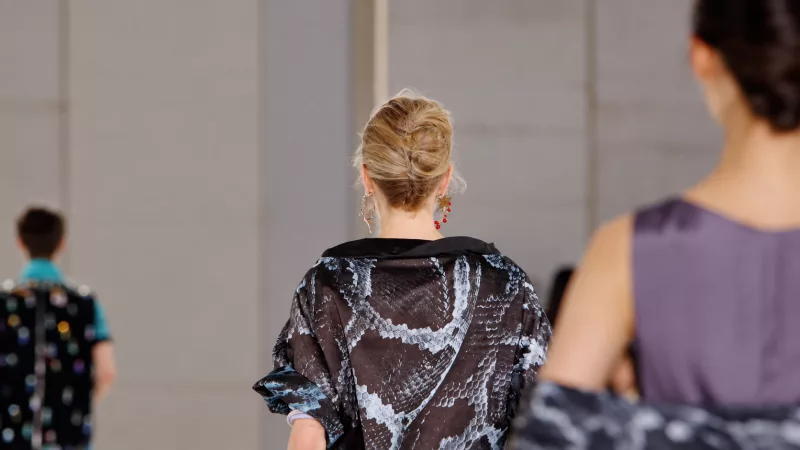
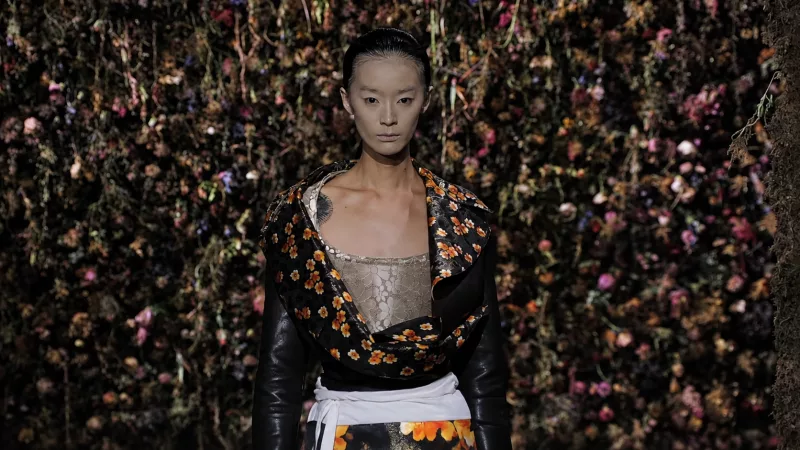
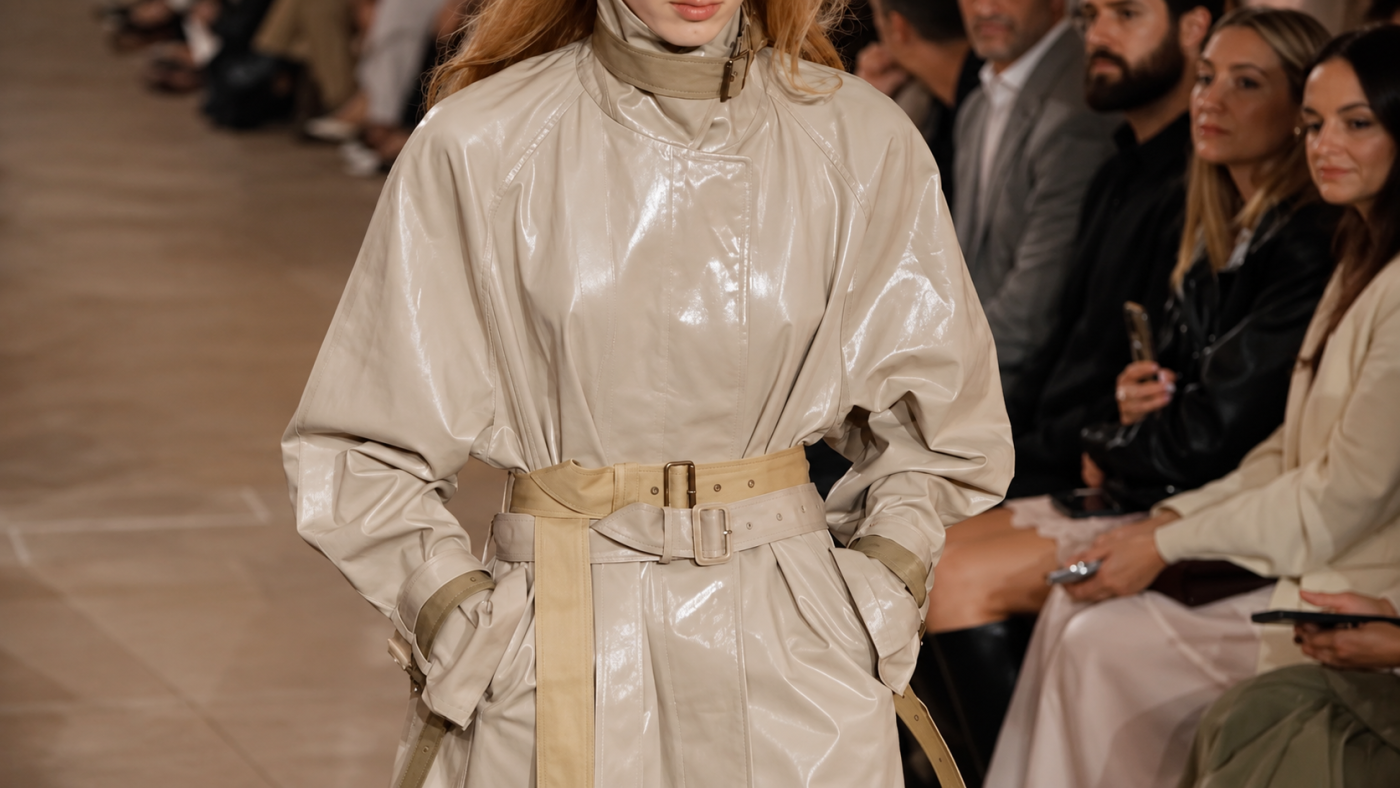
The contrast is worked into the surfaces, crisp glossy taffeta against leather that has been aged, lacquered or faded at the edges, and against denim that has been coated or printed with flowers, the print sometimes laid on as thickly as paint down the front of the leg. Historic luxury and worn utility end up on the same body at the same moment, and inside all that excess the house vocabulary stays legible, in the raw-cut hems, the vertical fraying along the outer seams of the legs, the jackets and gilets worn open over a bare midriff.
Johansson never left the house he founded, and that changes what an anniversary collection can be, because instead of revisiting an archive he put an object under load. He took the one thing Acne Studios genuinely owns, the 1996 jean, and loaded it with knots, drapery and volume until what was left of the jean was the material, while the shape belonged to historic dress. The risk he named himself sat precisely there, since decorative excess resting on nothing would have been costume work. Here it stays anchored to the material the house began with, and the ship, to keep his own image, does not go down.