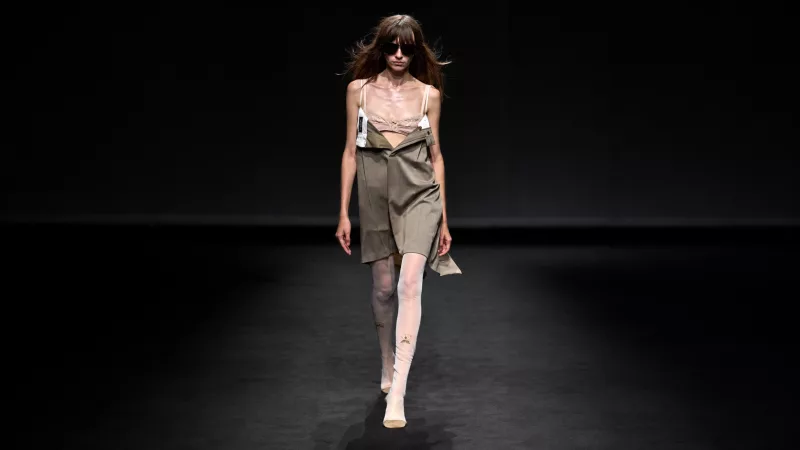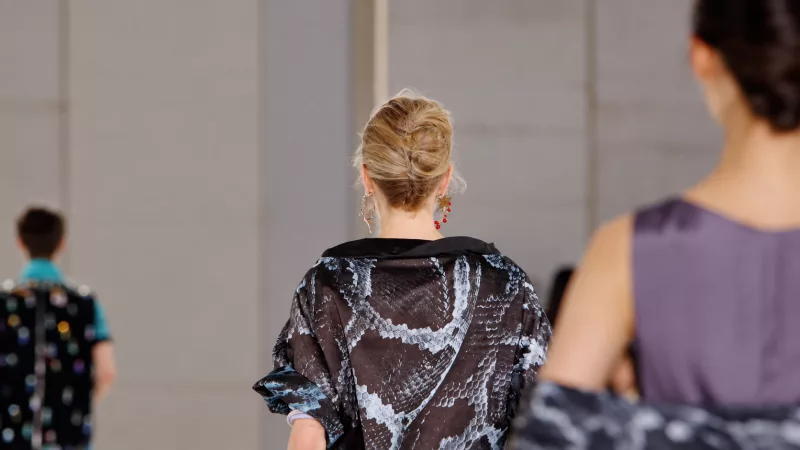



Glenn Martens arrived at Maison Margiela in January 2025, after John Galliano's ten years, and with this fourth collection he brings the house back to Paris after the season it staged in Shanghai. It is the easiest collection to wear he has made for the house, and the first to leave us unconvinced. Not because it is wrong: because it is right in every respect, and in the end it asks the house for nothing the house cannot already do.
The show opens on a cotton gabardine trench carrying a mass of cloth gathered into a ring that falls across the chest. What follows works on the same idea of volume, produced by the fall of the fabric rather than by any internal frame. What we are shown is the vocabulary the house was built on, put back in one block and held together by cutting of a very high order.
THE CODES ARE ALL HERE, AND THEY ARE HANDLED AS REPERTOIRE
When Martin Margiela founded the maison in 1988, he put two things into it: garments that show how they are made, and an author who steps out of the frame. Martens says he went back to that attitude on purpose: "Martin Margiela was about the anti when he began in the late 1980s, so we really worked with that," he explained after the show. That grammar comes back whole and all at once.
Some codes are simply held as they are, starting with the split-toe boot, which recurs through a number of looks.
Others change scale, and that shift is the most visible thing in the first stretch of the show: on the trench and on other outerwear the draping across the chest swells into a volume of its own, while the open macramé net stops being a detail and becomes the measure of the whole garment.
What we do not find, across the looks we went through one by one, is a code put under question: nothing is dropped, nothing is carried anywhere it hadn't been before. The repertoire widens in proportion and stays the same repertoire.
One movement of silhouette does get put back into circulation, and it is worth saying so: stirrup trousers, returned at tailoring scale, lengthen the leg and redraw its balance with the torso. It is a move, and also a return.
THE CRAFT IS AT ITS BEST; THE QUESTION IS WHERE IT IS SPENT
Bias cutting is the point at which this collection needs nothing else. Dresses and skirts fall in a column with no rigid construction beneath them, and the draping frames a painted print without pulling it out of shape, as on the dress carrying a large eagle on a pale ground. The hand shows.
Where the collection tries to add something, though, it adds a surface, and Martens gives his own reason for it: "You have to speak to a much broader clientele than Martin used to have. We have to speak to the world, so it's a bit difficult to go as hard on concepts," he said. Through the second half a glossy, waxed-looking finish is laid over floral prints, and the clearest case is a red midi dress with lace set on top of it. On a long sleeveless circle dress, crushed silverware is mounted across the front like a breastplate, over a garment that is otherwise fluid, the same monumental streak Martens claims for himself: "I'm the guy who's in churches all day long. Opulence, that's me."
These looks hold the eye longest, and they remain isolated gestures. Under that silverware is a circle dress the house has been cutting for years; under the glossy finish is a floral print that would have served exactly as it was. The finish moves; the garment's language stays where it was.
Colour stays inside the repertoire too: bright tones return at intervals right through the show, set against greys, beiges and blacks, while the close settles on a nude tone. It is the range this house reaches for when it does what it does best.
Between 2014 and 2024 John Galliano led this house taking the founder's codes somewhere they had never been, rather than setting them back in order: that is still the measure the maison is held to. The final dress, sheer chiffon cut on the bias and draped into a column, in a nude tone, is the most recognisable gesture the house has, executed as well as it can be. Martens has chosen to show us what the maison already owns.