
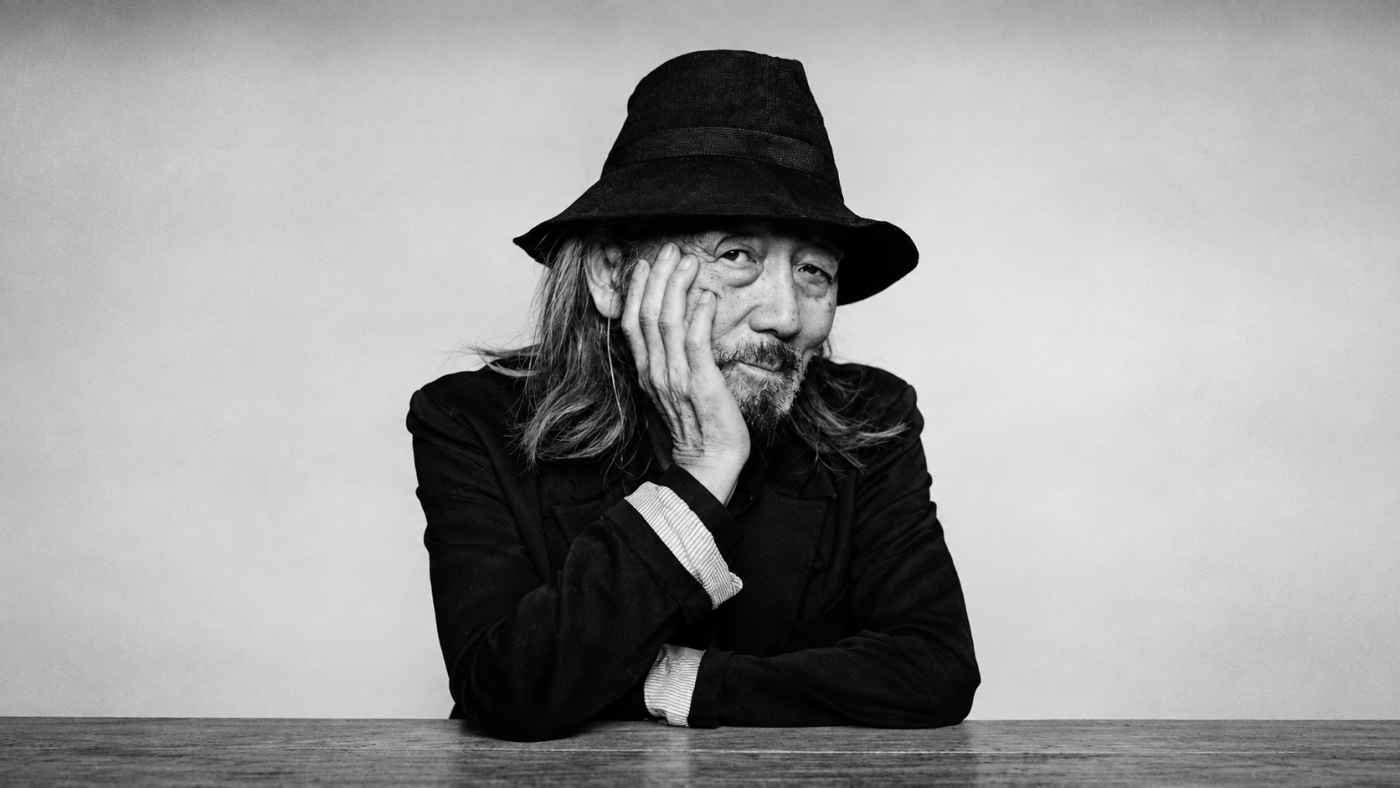

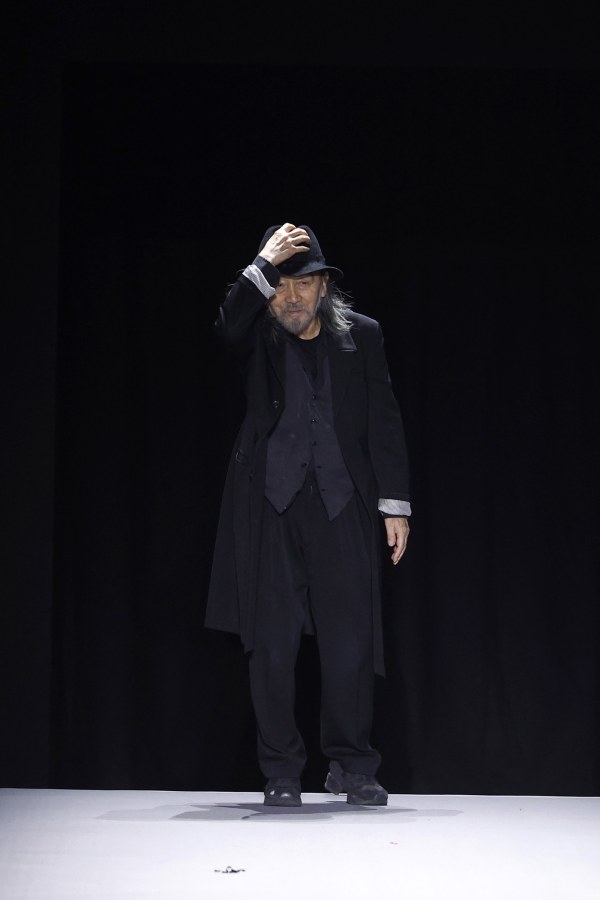
The strongest thing we saw in Paris for spring/summer 2027 carries Yohji Yamamoto's name, and we do not write that out of deference to a long career. Born in Tokyo in 1943, Yamamoto turns eighty-three in these show days; he opened Y's in Tokyo in 1972 and brought his own flagship line to Paris in 1981; since then the house that bears his name has had a single author, with no predecessor and no succession to discuss. More than forty years on, the test that counts for a master of the avant-garde is one of manner, of whether the original move has hardened into formula. This collection answers on the clothes, because the impulse that landed in Paris in 1981, taking a garment apart in order to build it, still produces an object that was not there before.
BLACK AS A LANGUAGE, FRINGE AS STRUCTURE
The show begins in darkness and sets out its vocabulary there: sculptural drapes that start at one shoulder and run diagonally to the waist, panels laid over one another with raw hems, stiff flaps jutting out from the shoulder line. The fringing in those first looks hangs from shoulders and hems with a weight no trimming would carry, because these are structural threads that make up whole sections of a garment: on one opening dress the skirt carries thick fringe from mid-thigh to ankle, under overlapping panels of cloth.
Black works as a language rather than as a colour, and it is the dominant tone in nearly every look. Inside that language the dress carries most of the argument, largely asymmetric, sleeveless or one-shouldered, with hems cut to uneven lengths.
Then comes a substantial break in colour, a run of abstract graphic prints in purple, green, blue and yellow on dresses of soft volume. The colour comes up without overturning the scheme, and this is not the only point where it does so.
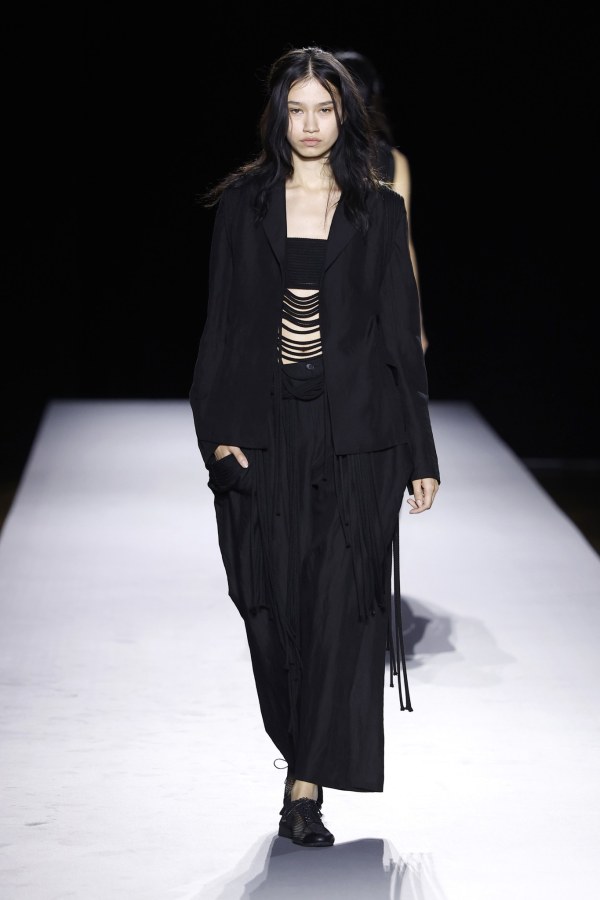
Straight afterwards men's tailoring returns, his founding code, and Yamamoto hollows it out from the inside: notch and peak lapels stay recognisable, the shirting moves to sheer cloth, knotted white cords are left in view, the trousers reach a very wide volume. The jacket keeps its cut while losing its substance, reduced to a veil.
In the finale the deconstruction reaches a point it had not reached before. Strips of cloth woven by hand form the bodice as a grid of vertical and horizontal ribbons, the weave then stops at different heights, at the hip in the centre and below the knee on one side, and the loose ends hang free, dropping like long ropes to ankle and floor. Woven cloth is dematerialised into an armour of ribbon and slack thread, with a tactile weight not seen before. This is where the form unravels without falling, because the grid holds.
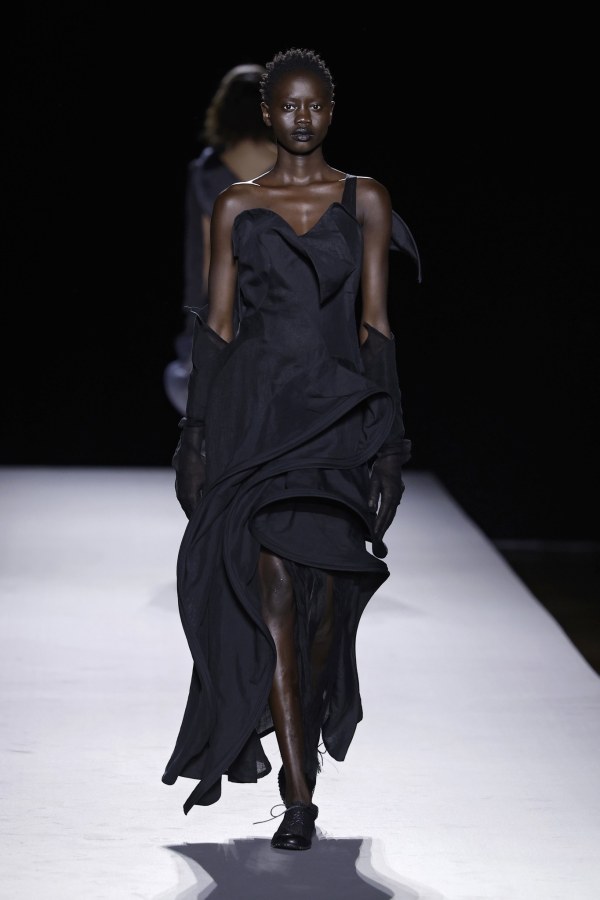
The sheer work holds all of this together and it has a stated reason: opaque dresses sit alongside chiffon, open knit and mesh, the grid uncovers skin, dense volumes frame empty space. After the show Yamamoto explained that the techniques letting the body show through were his answer to the overheating of the planet, and he finished with two words: "Enjoy summer!" Asked about the decades spent working out those techniques by hand, and about the pleasure of making them, he said that "Process is suffering", and on how the collection had turned out he offered only "I really don't know…". A man who has built a method over forty years still calls the labour by its name, and once the show is over he still will not settle the verdict himself.
With no scenographic distraction, a slow walk and a folk soundtrack that included "Unchained Melody", the spectacle was the build-up of the techniques themselves. Red returns at the end as it had appeared at the start of the material exploration, in a dress made entirely of dense vertical red fringing over a black base, with a black sculptural structure of woven tubular elements wrapped around the neck: it seals the show shut.
The house is the man who founded it and has run it alone for more than forty years, with no one else's archive to reread and no inheritance to administer, so that every season measures him against himself. The proof that he remains a master of the avant-garde therefore lies not in the accumulated career but in one precise fact: the gesture he brought to Paris in 1981 now yields a hand-woven grid of cloth strips belonging to no earlier repertoire. At that level consistency is not repetition, it is a language still moving inside itself.