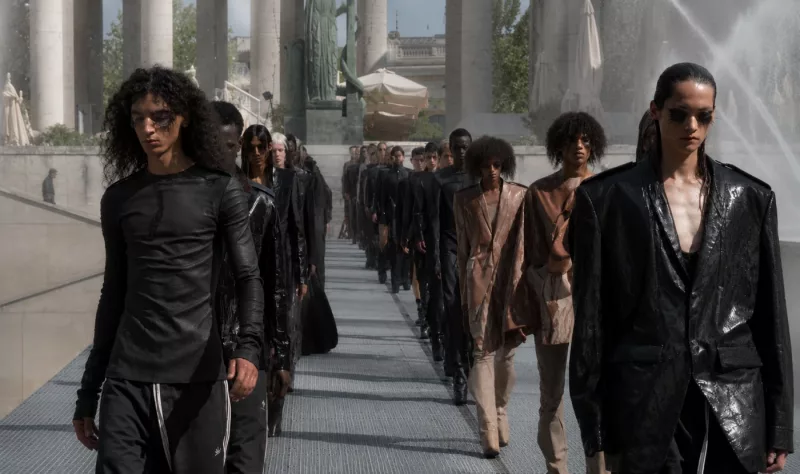

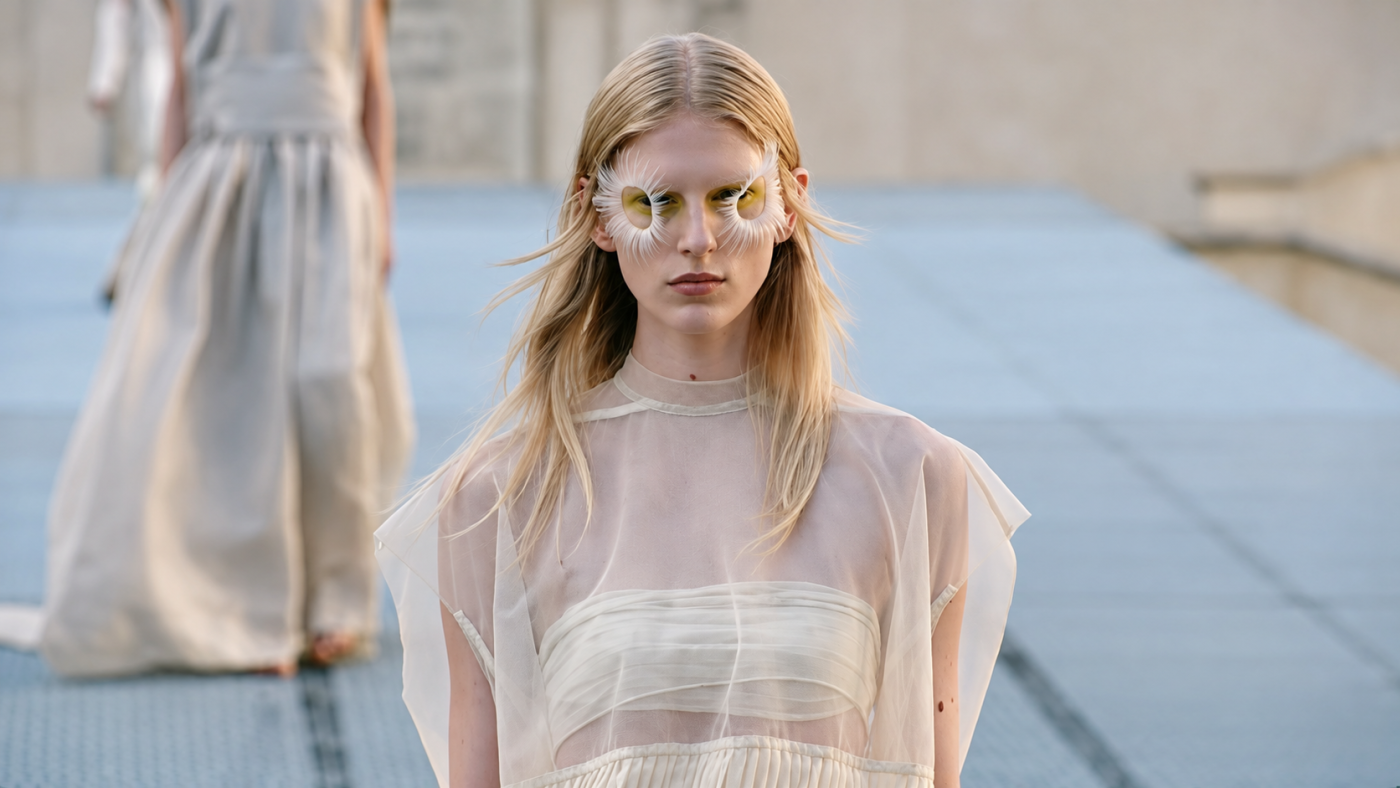

Of everything Paris has shown for spring/summer 2027, this is the collection that sits furthest ahead. It is signed by Rick Owens, who founded his own house in 1994 and has drawn every collection since, with no creative director before him, so that the history of the label is his own. The proof is not a mood but a construction: the tensegrity he showed in June's men's collection, where it was leather and rubber over aluminium bars, remade here for women in foamy tulle strung on elastic cords.
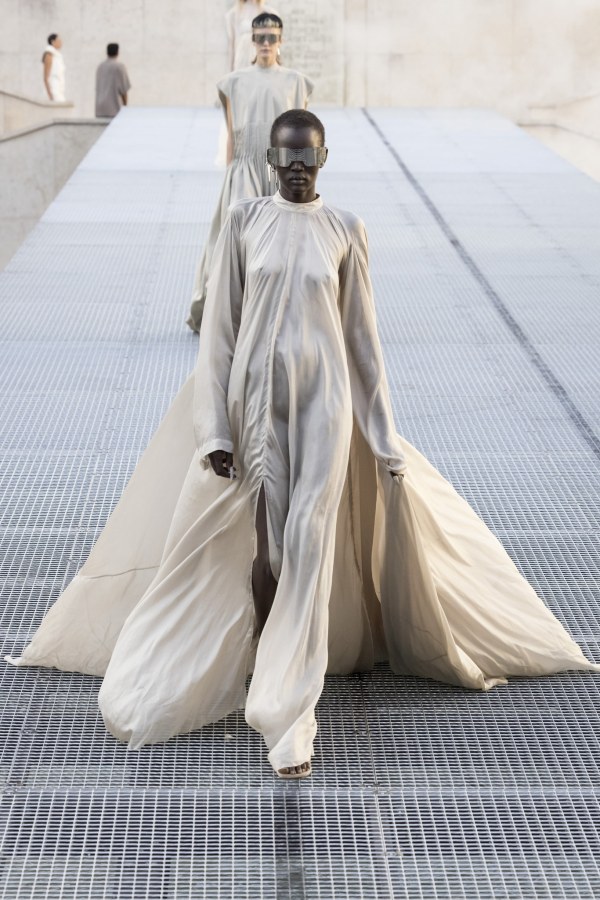
The starting point is a few steps from the studio, inside the basilica of Sainte-Clotilde, which Owens visits for reasons that have nothing to do with faith. "I'm not a religious person. I just go because it's a beautiful old building in Paris. It is an extension of my living room, almost," he said backstage. The colour and the bearing of the column dresses that open the show come from what hangs on those walls: stone-coloured, some of them cut in rigid canvas and others in light fabrics that the wind lifted along the sloping runway built in the open air over the reflecting pool of the Palais de Tokyo. Pointing at one of them, he explained that "that is in one of the old, grimy, dark paintings in that basilica that I see almost twice a week", before giving the word that holds the rest together: "When I looked at them, I was thinking, 'Oh, stoicism — that kind of dignity that I'm always thinking about'". It is dignity made into a garment before it becomes a structure, and the same bearing runs through the silk dress that Owens calls the Clotilde dress, after the painting in the basilica.
Then comes the passage that overturns his own codes, and that Owens calls perverse by his own standards: "I thought, what could be more perverse coming from me before than pretty, sparkly shoes," he said of feet wrapped in thick crystal ropes. The same swerve produces the elaborate black tulle he calls brutalist lace and the tensegrity pieces, of which he says, "So they kind of became negligees to me." The research is in the mechanics. Where the men's show had aluminium and leather, here there are tubes of gathered tulle held in compression and elastic cords held in tension, a soft cage that behaves like a mechanism rather than like a dress. He tried one on before sending it out: "I was fine. The elastic just moves everything around, and then when you get up, it all snaps back into place."
None of it stays on the runway. The same construction logic is legible on clothes that will reach the shops: a cropped top with long sleeves and raw-cut cuffs, worn over a sleeveless tunic that stops at mid-thigh, above wide-legged trousers that pool on the floor with frayed hems.
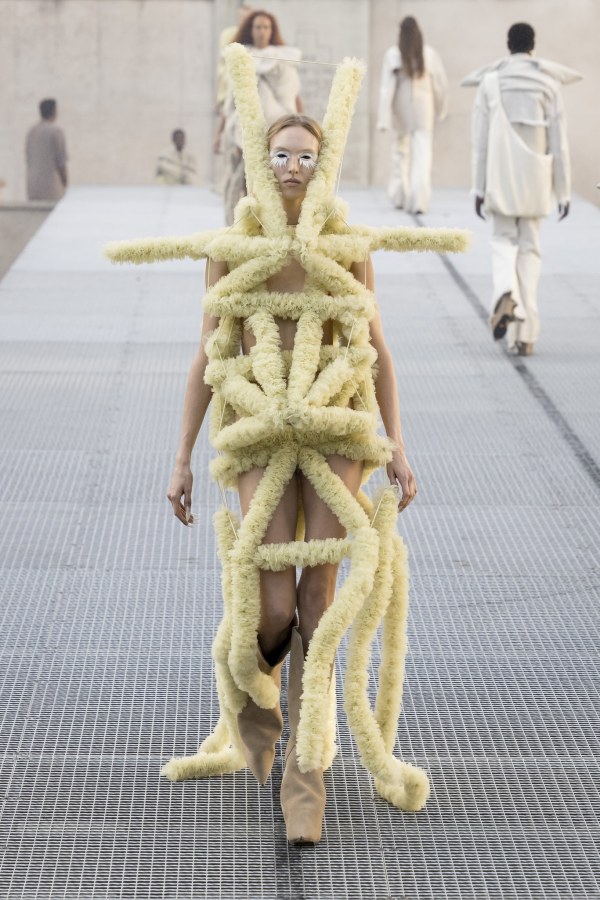
The collar is the motif that runs through the show, taken up in several variations: first the sculptural collar projecting horizontally, then the ring of gathered fabric rising to cover chin and mouth. Alongside them come the rigid shoulders, pushed out past their natural line. By the finale the structure has taken over, and the straw-yellow tulle sculptures wrap the body, some with horizontal bars at the shoulder, others with vertical elements climbing past the head, trailing lengths dragging along the floor, all of it held by thin, visible tension wires. The last look merges the giant pleated top with a lower harness of hanging tubes. What holds the argument together is the contrast of materials, heavy cotton canvas and denim on one side, weightless tulle on the other: a collection built around the long dress, taken apart piece by piece until only the scaffolding is left standing.
Three decades after founding the house, with nobody above him and nobody after him, Owens is still pushing form further than anyone else, and he does it with a method that can be tested on the body: the dignity he found in those dark paintings takes the shape of a mechanism that holds, the elastic moves everything around and then it all snaps back into place.