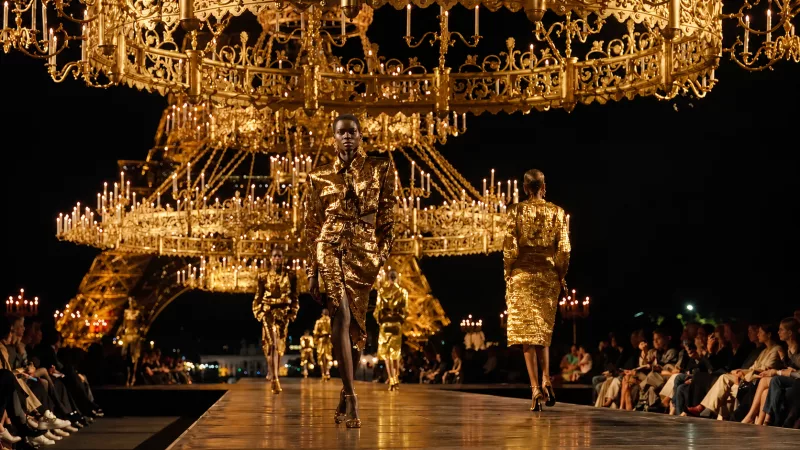

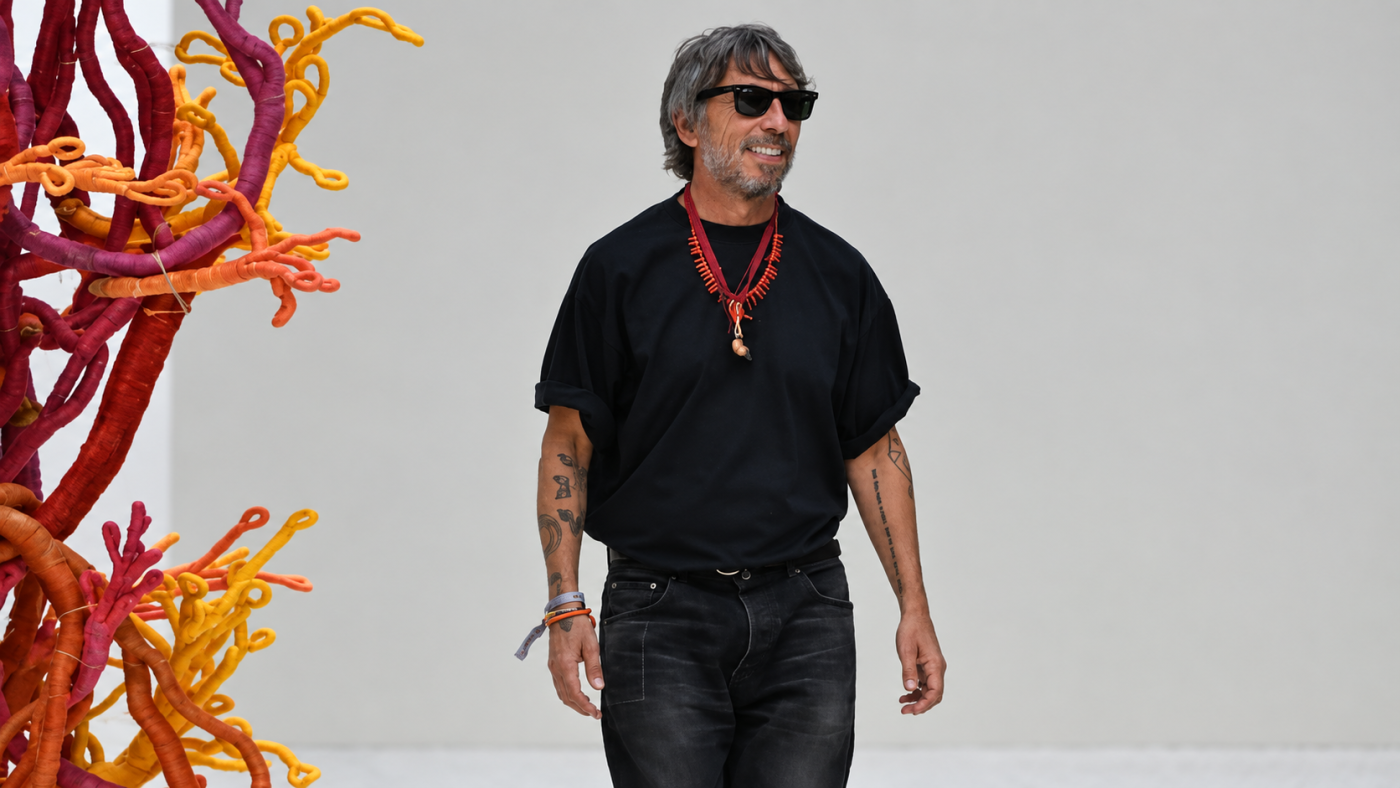

The house was founded in 1919 in San Sebastián by the Spanish couturier Cristóbal Balenciaga. After the ten years of Demna Gvasalia, from 2015 to 2025, Pierpaolo Piccioli took over the creative direction in July 2025, and this is his fifth collection. Here he takes a line of his own, and he takes it by removing weight rather than size. While the season around him piles on ornament, he strips it off, and the result is the cleanest and most counter-current thing shown this season.
The proof comes out near the end of the show: a black sphere. It is a cape, spherical, covered all over in dense broad fringing, falling from the shoulders to the top of the thigh with no sleeve cut into it, and a pair of shorts shows underneath. It is the largest garment on the catwalk and it is made of almost nothing but fringe. The principle behind Piccioli's spring/summer 2027 is already in it, which is that the Balenciaga scale stays exactly where it was while the cloth changes completely.
THE VOLUME STAYS, THE CLOTH CHANGES
The house shapes are untouched. Dropped shoulders run through the outerwear and the shirts, the wide leg remains the dominant trouser measure, with hems that in many looks come down to brush the floor, and the exaggerated volumes everyone knows are all in place. The show notes published by the house put it like this: "Balloon, drape, cocoon. Breathe, hold, release." The cocoon brings in the founder, whom those same notes name when they read the collection as an evolution of his obsessions.
What changes is the material. The house calls its own code engineered materiality and describes it as "an integral part of the house's DNA, engineered materiality is a vital instrument for invention… translates anew to an innovative featherweight techno taffeta". The principle by which the fabric is developed stays the house's own, while the direction it is pushed in changes, away from very heavy silhouettes and towards a featherweight technical taffeta.
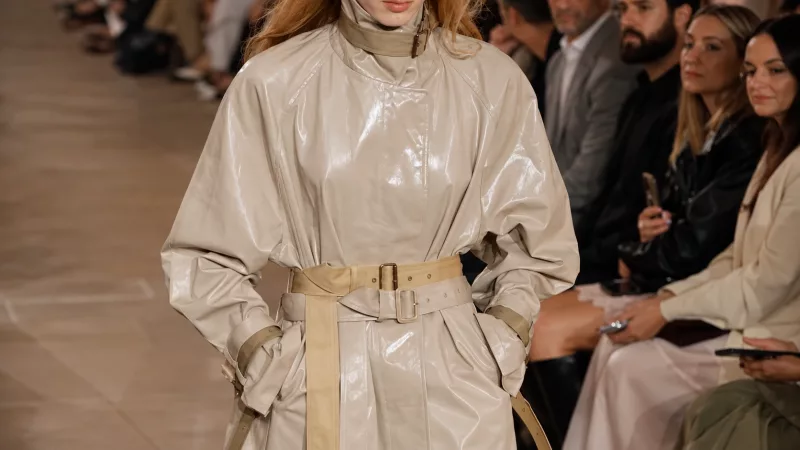
The starting point is not the archive either. There are no literal historical references in these clothes. What there is instead are the archetypes of the everyday wardrobe, the shirt, the trouser, the blazer, denim, the trench, ordinary garments to which, the house writes, a new significance is given. Same scale, opposite material.
THE EVERYDAY GARMENT, LIGHTENED
The show opens on a run of pure whites, cream and pale beige. A white shirt is tight at the waist and flares into a peplum over the hips; straight after it comes a white cape with full volume, worn open over a bare chest and fastened at the throat by a rectangular gold element, its back hem long enough to form a train, over five-pocket trousers. The cleanliness is there in the colour and in the fall of the cloth, before any decoration arrives.
Then the material begins to empty out. Tulle, mesh and lace show the underwear rather than hiding it, and one black dress holds itself on a sheer base, with wide vertical fringes that gather into a draped band at the hip and drop free to the floor from there, over lace culottes. Denim arrives with heavy abrasion and tearing across the front of the legs and with frayed hems. The tailoring is taken apart and put back together another way: one jacket wraps shut with no visible buttons, another fastens on the diagonal. An oversized jacket with a broad collar, metal buttons on the lapels and a dropped shoulder sits over a plain skirt carrying a wide band of fine fringing applied from the hips down. The garment always stays recognisable; it is the construction that opens up.
In the finale the bulk goes to its maximum and the material to its minimum. As well as the spherical black fringed cape there is a pale pink dress in sheer fabric, its built-in cape covering the arms and running into a train, worn over matching sheer trousers. The show notes are plain about what that produces, "Lightened, entire ensembles weigh less than a kilogram".
The collection is called UNSIZED - A LIGHTNESS OF BEING, and by the end of the show that title has stopped being a statement of intent and become a measurement. After five collections Piccioli no longer has to prove that he has understood Balenciaga. He has left the dropped shoulder and the wide leg exactly where they were and moved the one variable the house had not yet touched, which is how much all that volume weighs on the body.