

The "Our Story" page on the Fyfe Golf site carries no street address. Instead it carries a pair of coordinates: 56.3438° N, 2.8031° W. Put through a reverse geocoder, they land on Golf Place, St Andrews, the road alongside the Old Course. The workshop is in Fife and has no published address, so the brand pins itself beside the birthplace of the game and leaves the sewing room off the map. The point is not where the cutting table stands, but what goes over the club.
THE OBJECT
The catalogue holds headcovers for drivers, fairway woods and putters, rangefinder cases, hand forged ball markers, merino beanies, shoe bags, pouches and bamboo tees, a wardrobe of accessories with a different job in each. Everything is made to order in Fife, and the custom programme takes a family or club tartan, initials, an embroidered crest.
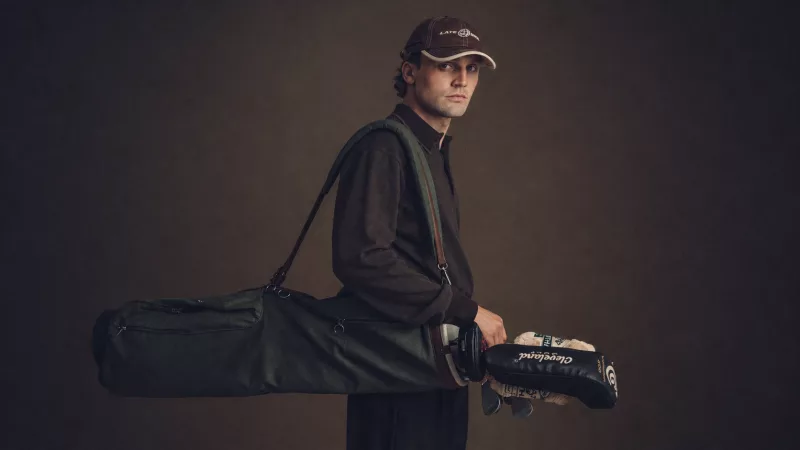
The line the brand gives itself is "Woven to the Game", and the design direction works by subtraction: natural materials and no shouted logo, with a small green tag stitched where others put a badge. A headcover has no silhouette to draw and no graphic to compose, so the styling decision comes down to one variable, which cloth. The Nightwatch tartan is a dark variation on Black Watch Modern, spun from 80 per cent recycled fibre; the Arran headcover, £65, has a pure new wool shell and carries the Harris Tweed Authority mark beside the words "Certified Harris Tweed".
THE CLOTH
Each name answers one question, what the thing is made from. Harris Tweed is handwoven by islanders in the Outer Hebrides and remains the only cloth in the world protected by an Act of Parliament, the Harris Tweed Act 1993; every fifty metres an inspector from the Harris Tweed Authority checks it and stamps it by hand. The waxed canvas comes from Halley Stevensons in Dundee, at Baltic Works since 1864. The tartans are woven in Selkirk and Perthshire, no mill named, while the merino in the beanies is, by the brand's account, from Todd & Duncan on the shore of Loch Leven.
Provenance here is the form. In golf, "made in Scotland" is usually a tag inside a collar; in this range it is the reason the object exists at all. Mark Hogarth, creative director at Harris Tweed Hebrides, recalls photographs of Old Tom Morris laying out courses among the dunes dressed in Harris Tweed, "the perfect performance sportswear of the day". The technical kit of early golf was this cloth.


ON THE COURSE
The headcover goes over the driver and the putter, the ball marker holds a spot on the green, the beanie earns its keep on a links in November. Fyfe calls itself a digital-only brand and sells online and through some fifty pro shops in the UK and Canada, so the object lives on the course and in the club shop rather than in fashion retail. Neil Rennie founded the brand out of fashion rather than golf, and after years in Scottish pro shops he found "a real disconnect between where the game began and the products being sold within it".
The longest running collaboration is with MacKenzie Golf Bags: the Walker bag, waxed canvas and full-grain leather with a tartan lined pocket, £650, a numbered edition, sold out. It takes its name from Rick MacKenzie, the caddie assigned at St Andrews in 1985 to the two American brothers who took the bag he carried as their model. Scottish cloth leaves the country and comes back inside an object named after an Old Course caddie.
THE SMALLEST THING IN THE BAG
A headcover is the smallest and cheapest thing a golfer carries, and it has the longest chain behind it: a weaver at a loom in her own house, an inspector stamping every fifty metres by hand, an Act of Parliament, a workshop in Fife cutting and sewing to order. All of it ends in a three-second gesture on the first tee, pulling a woollen cap over the head of a driver.