

Matières Fécales presented its Spring/Summer 2027 collection in Paris on Monday 28 September 2026. The collection pairs a resolved tailored cut with an unfinished edge: structured pointed shoulders, a cinched waist, and skirts cut to match, while the jacket's peplum stops in a fray and the skirt is left open at the bottom. The cut is finished; the edge is deliberately left open.
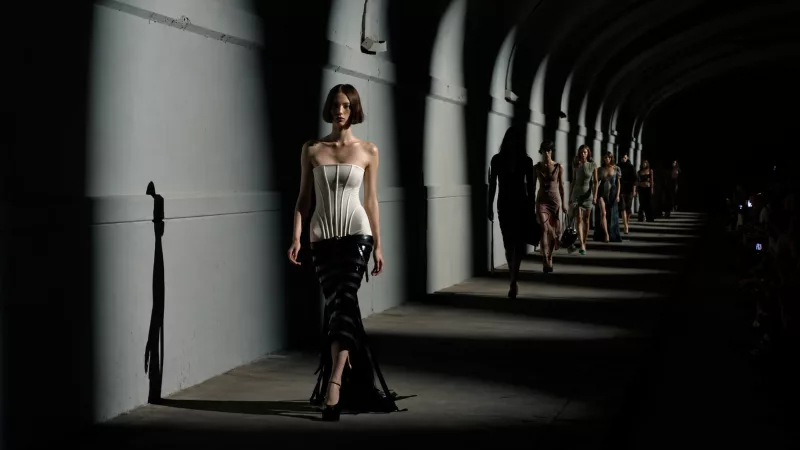
Near the top of the show there is a pale tailored look: structured pointed shoulder, cinched waist, skirt cut to match. The jacket's peplum stops in a fray, and the skirt is left the same way at the bottom. The cut is that of a resolved tailored garment, while the edge has been left open. Matières Fécales showed Spring/Summer 2027 in Paris on Monday 28 September 2026 at 7pm, closing the opening day of the women's week, and this is around the fourth catwalk Hannah Rose Dalton and Steven Raj Bhaskaran have staged on the official schedule, a few seasons after their debut: the point at which a label that grew up outside the system becomes a house inside the calendar. The aesthetic the pair are known for stays on the body here, and it now reaches the way the clothes are finished.
THE ALTERATION CHANGES SCALE
The show opens on a pale one-shoulder drape with a train, and under the fabric, across the front, a prosthetic volume has been added at the stomach. After the halfway mark, the model wearing a shaped denim jacket with very long sleeves left open and a frayed miniskirt has red nails taken to an extreme length. Towards the finale, a one-shoulder bodice gives way to an enormous tulle crinoline with a frayed hem.
The label's codes are all here, and the treatment they get is visible. The anatomical alteration stays, and it keeps its place on the body. What shifts is the scale, because by the finale the forced proportion sits on the garment that contains the body rather than on the body. The tailoring, though, is contradicted: the most composed look in the collection is also the one with the poorest edge. On this reading, the alteration stays on the body, and now reaches the clothes too.
THE CUT IS FINISHED, THE EDGE IS NOT
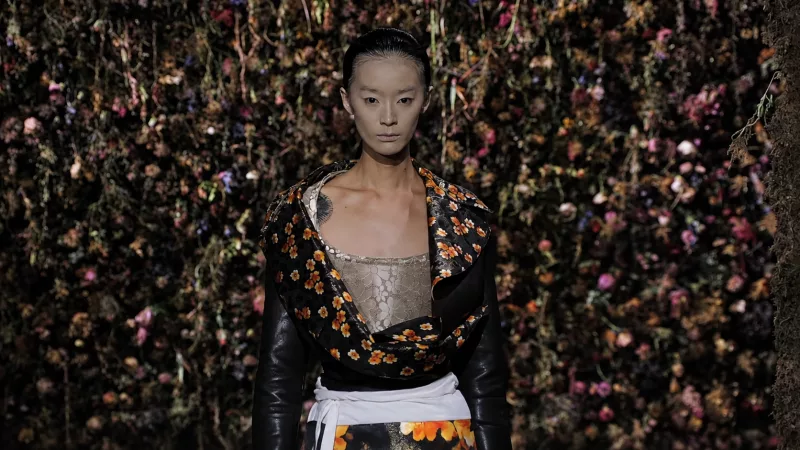
Look by look the rule holds: the cut goes all the way, while the finishing stops short. In the tailored look near the opening the shoulder is structured and the waist tight, while the peplum stops in a fray above the matching skirt. In the denim jacket from the middle of the show the sleeves run very long and stay open, and the miniskirt under it is frayed at the hem. Elsewhere there is denim whose surface looks like thick scales, split by wide tears. Tulle is not only there for volume: built up over a structured garment it produces sheer jackets and tops run through with tight gathers.
Then come the added surfaces. Towards the finale a pale structured top sits over deeply torn jeans, with a large feathered hat, and in more than one look fabric extensions sewn onto sleeves and hips trail along the floor. The drapery works the same way, since the fabric is pulled and gathered, the fold does not fall straight and the asymmetries stay unresolved. Colour moves in an arc: white at the opening, the break into black, flashes of red and orange, the long military passage of olive green and dark denim, evening at the end. The strangeness here lies in how the clothes are finished rather than in what they are.
THE WARDROBE IN BETWEEN
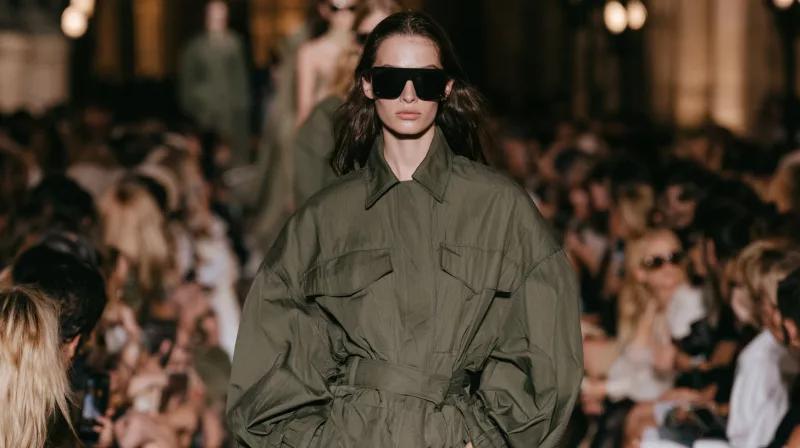
The show runs to more than ninety looks, and what fills the middle is a real wardrobe, made of clothes recognisable for what they are rather than a handful of statements repeated on loop. Halfway through, an oversized bomber comes with laced thigh-high boots and a mask; further on, a ribbed knit cardigan returns, buttoned up, with the long skirt close to the body and the stitches left laddered. The same double gesture holds for both: the cut resolved, the surface and the edge left open. Repeated on a wearable garment, that gesture becomes a method instead of a mannerism.
Seen from outside, a label arriving at around its fourth show on the official schedule has to take the alteration into the craft of the garment rather than leave it to the spectacle on the catwalk.
Near the close of the show comes a fluid, pale suit cut on masculine lines, worn by a model holding on one shoulder Two "dead " mannequins, dressed in black. The figure is doubled through the clothes, without a body being touched. At around the fourth official show the body is still the site of the alteration, though it is no longer the only one: there is also the hem of a jacket.