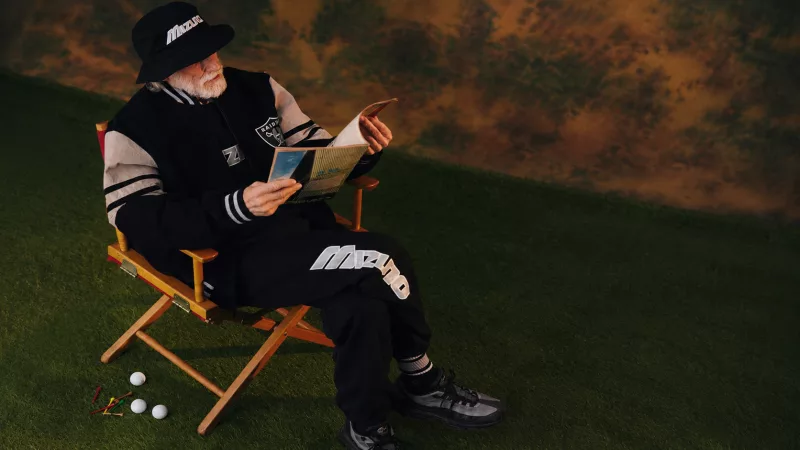



Golf as visual culture, panel four: a Japanese luxury house treats the fairway as a stage for technical elegance. Polartec inside sartorial 3D patterns, a real pro (Shigeki Maruyama) choosing the fabrics, and an Italian name that deceives.
"One plus one equals three." An Italian proverb about combined strength, printed on the label of a golf line from Tokyo. 1PIU1UGUALE3 GOLF skips the sports trade shows and shows at Rakuten Fashion Week TOKYO instead; its 2024 S/S show ran at Shibuya Hikarie. The Autumn/Winter 2026 collection is now in preorder, with deliveries expected between September and October, and its signature piece, a ¥132,000 POLARTEC ZIP HOODIE, pairs a high-tech fabric with Japanese 3D tailoring. This is the fourth panel of golf as visual culture: after character, archive and material, the atelier. An Italian name over a deeply Japanese identity.
THE ATELIER ON THE FAIRWAY
Tomohiro Ozawa founded 1PIU1UGUALE3 in 2011. The house is known for made-to-order suits and high-quality leather goods, and runs a Japonism line with Kyoto obi master Honda-ya Genbei. Golf here extends the atelier rather than diversifying the catalogue, and expresses the "UVER" philosophy, the pursuit of the supreme and ultimate. The 113 GOLF POLARTEC ZIP HOODIE is its emblem: US-made Polartec, chosen for heat retention, breathability and lightness, cut with "3D tailoring (立体裁断)" to follow the body, a silhouette "snug yet moves (タイトでありながら動ける)" that leaves the swing free. The 3D pattern is a hallmark of the brand's tailoring. The clubhouse vocabulary gets a luxury reading: TUCK PANTS, VELOUR PIPING, MOCK NECK BLOUSONS, SADDLE SHOES, WING TIPS. The knit jacquards carry cultural motifs: the dancing crane (the brand's symbol), a bird in a cage, melting letters, a homage to the Coogi jacquard of 90s hip-hop. Golf becomes the ground where functional sportswear meets high-end tailoring: performance fabrics, atelier construction.
A TRUE PRO, NOT A CELEBRITY ENDORSEMENT
1PIU1UGUALE3 GOLF did not hire a face; it built a wear partnership with Shigeki Maruyama, a legend of Japanese golf. AKM's press release of April 16, 2025 lists three PGA Tour victories, ten wins in Japan and the 2002 Golf World Cup. Maruyama coached the Japanese Olympic national team for three consecutive Games and is expected at Los Angeles 2028. According to EVEN magazine, he "participates from the fabric selection phase" in co-creating the CLASSIC line. The concept is "魅せるゴルフ" (show golf): a lavish monochrome style with meticulous forms, built for courses with strict dress codes and occasions that demand a certain elegance. "I want to go with the traditional line (トラディショナル系でいきたい)," Maruyama said. Where other crossovers hire celebrities, here the game is woven into the product rather than printed on its surface, and the clothes answer the social code of exclusive golf.
THE ITALIAN NAME THAT DECEIVES
The paradox extends to distribution. Six direct stores, all in Japan, among them Ginza SIX and the 45th floor of The Ritz-Carlton Tokyo; e-commerce in Japanese only. In Europe the brand stays close to invisible, even in avant-garde fashion circles. No international flagship is documented, only occasional collaborations that gesture at Italy: the ADP GOLF line with Alessandro Del Piero, projects with ACATE Milano. The Italian name (1+1=3) and those rare foreign ties sit on the surface of a structure that is Japanese through and through: a Tokyo luxury house playing a Scottish game while speaking Italian. We read the scarcity as deliberate strategy, luxury-as-removal: preorders, limited production, a near-exclusive Japanese presence, "one arrival." The operation asserts itself without export. No European outlet has yet told the story from this angle; this one does.
THE CIRCLE
Back to "one plus one equals three." Golf and tailoring together give the atelier on the fairway, the fourth direction of golf as visual culture. The closing image is the POLARTEC HOODIE, American technical fabric, Japanese 3D pattern, crane patch on the chest, worn on a Tokyo fairway. Fashion golf chases short-lived hype; the more radical luxury takes shape in a language Europe fails to recognize as Japanese because it is written in Italian.