


Paris Fashion Week for spring/summer 2027 went looking for lightness without giving up black. Houses made their fabrics lighter, with sheer layers, silk, tulle and chiffon, and brought the wardrobe back to everyday life, with trousers, jackets and skirts. On colour they took few risks: black is the dominant colour of more than one look in four and the main colour of almost two shows in three. In a season shaped by changes of creative director and difficult accounts, Paris chose to experiment with material and to stay cautious with the palette.
That judgement rests on our own analysis of the runway photographs: 62 of the 68 shows on the official calendar, from 28 September to 6 October, plus Enfants Riches Déprimés, which showed off-schedule. In all, 3,189 looks, each read for dominant colour, garments, silhouette and materials. Twelve of the shows we had already analysed in detail for our reports; the other 51 were read with the same method in a more concise form, which is enough for season-wide figures. Weinsanto, Agnès b., Ujoh, Litkovska and Pierre Cardin are missing, as complete galleries were not available.
LIGHT, BUT IN BLACK
The word designers used most often this season was lightness, and the figures bear it out. Some 23% of looks were visibly sheer, and in 17 shows the share was above 30%. Yohji Yamamoto and Ester Manas led, with sheer elements in almost two looks out of three, followed by Cecilie Bahnsen and Sacai. Among the most frequent materials, alongside cotton, leather and wool, were silk, lace, tulle and chiffon.
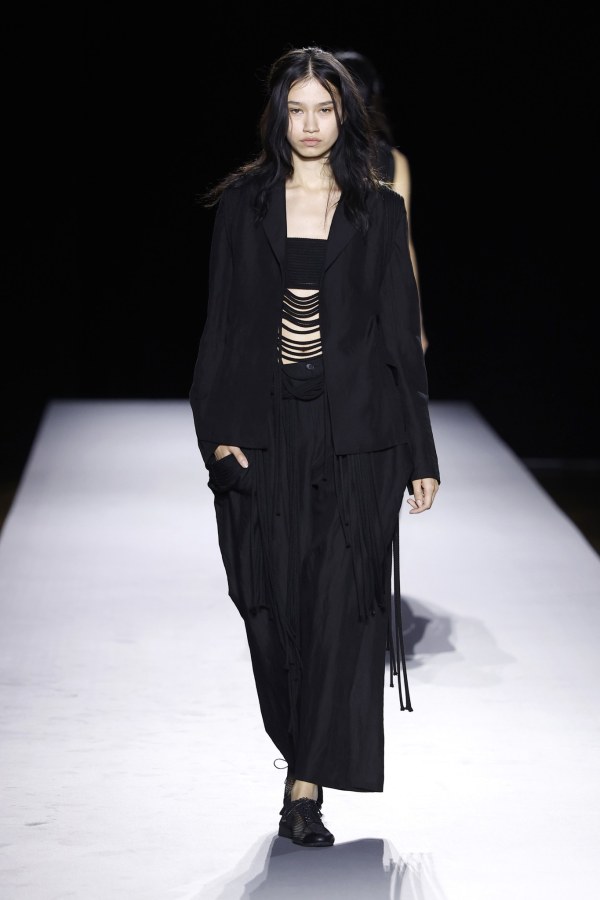
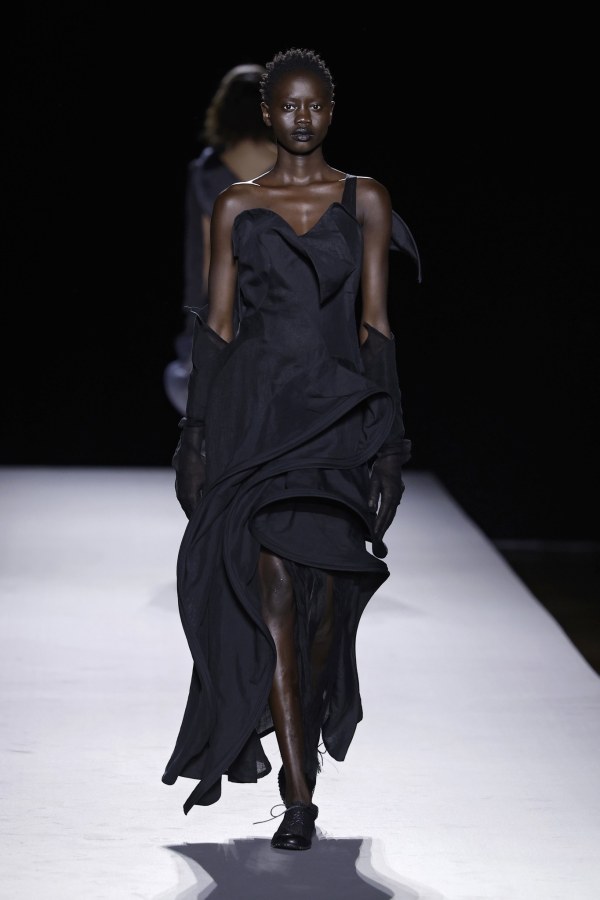

For several designers the reason was practical. Jonathan Anderson said his Dior collection "starts off with chiffon" and that he was "trying to remove the heaviness of the heritage of a brand like Dior". His answer to the heat was a set of soft, almost transparent versions of the Bar jacket and the circle skirts with which the house was founded in 1947. At Hermès, Nadège Vanhée worked around "a very simple notion of air", with pieces that shorten or open up with a zip. Yohji Yamamoto said he was once again responding to the heating of the planet. Nicolas Ghesquière described the effort at Louis Vuitton precisely: "It's an impression of minimalism, but the work behind this construction, the simplification, making things extremely light, is really complex."
The lightness, though, came almost entirely through the cloth. Black is the dominant colour in 28% of looks and the main colour of 39 shows out of 63; add greys, navy, browns and burgundy and dark tones account for 42% of all looks. White, cream and beige reach 24%, and every other colour combined 34%. Yohji Yamamoto is the clearest case: the darkest show of the week, with 93% of looks in dark tones, and also among the most sheer. The exceptions came from different directions. Rick Owens and Jean Paul Gaultier showed the lightest collections, with more than half their looks in whites and neutrals, while Saint Laurent gave almost the entire show to gold before a finale in black.
THE WARDROBE GETS REAL
The season's second finding is practicality. Trousers appear in 35% of looks and in 60 shows out of 63; dresses in 33%, skirts and jackets in one look in four.
Designers said as much. Miuccia Prada explained that at Miu Miu "what I was mainly interested in is working for people now". Michael Rider, just over a year into the job at Celine, was blunter: "We're not living on the edge at Celine. You're coming to get real clothes." At Loewe, Jack McCollough said he and Lazaro Hernandez were looking at how to translate their ideas "into a bit more reality and a way of dressing". The archive, which at least seventeen houses drew on, from Chanel and Mugler to Dior and Courrèges, often served the same end: Daniel Roseberry, for instance, built part of his Schiaparelli collection around the house jacket while developing the more everyday side of its ready-to-wear.
There were dissenting voices, and they were clear. Saint Laurent presented a collection built on gold and evening dressing, far from the idea of fashion for everyone. Junya Watanabe worked on the staging of the runway itself, sampling and remixing two genres of show from the past.
ARRIVALS, RETURNS AND DEPARTURES
Caution over colour also makes sense given where many houses stand. Two creative directors made their debuts: Kai Nesselrath at Carven, after a long immersion in the house archive, and Drew Henry at Courrèges, who arrived only weeks before the show following the departure of Nicolas Di Felice. Henry said he struggles "with the neatness and the cleanness" of the label and wants to find a softer side to it. Jonathan Anderson, meanwhile, showed his seventh women's collection for Dior in a year.
Two names returned to the calendar: Sacai, with Chitose Abe back on the runway after a season off, and Ester Manas, absent for a couple of years. Maxhosa made its official entry onto the Paris schedule. The biggest change came after the week: on 9 October Saint Laurent announced the departure of Anthony Vaccarello, who had presented his final collection for the house on 29 September, ten years and two days after his debut.
Many houses experimented with what the body feels, the weight and transparency of a fabric, and played safe with what is seen from across the room, the colour. Sarah Burton, at Givenchy, put it in a sentence that holds for much of the week: "In a world that's very precarious I wanted to find a balance in it." Paris found that balance with lighter, more wearable clothes, almost always in black.